
 Watch video









 Sign in with Google
Monetization
How much can you earn on YouTube? TubeBuddy revenue calculator explained


TL;DR
- On YouTube monetization, you earn 55% of ad revenues once you join the YouTube Partner Program (YPP).
- The TubeBuddy YouTube Revenue Calculator helps estimate your earnings by projecting ad revenue, RPM, and overall income based on views, niche and engagement.
- Your niche, audience geography, engagement and video retention heavily impact CPM/RPM — finance, education, or tech content typically earns more than gaming or lifestyle.
- To boost earnings: produce high-retention content, target high-CPM niches and regions, foster engagement, and diversify revenue streams beyond ads (memberships, sponsorships, merch, etc.).
- Key metrics:
- CPM = what advertisers pay per 1,000 impressions.
- RPM = what you actually receive per 1,000 views after YouTube’s cut — a more realistic earnings metric.

Get an unfair advantage on YouTube
Give your YouTube channel the upper hand and easily optimize for more views, more subs, and more of every metric that matters.
If you’ve ever tried to figure out how much money you could earn on YouTube, you know how confusing the numbers can get. Between CPM, RPM, ad formats, viewer geography, and YouTube’s revenue share, estimating your real income often feels like guesswork. That’s where TubeBuddy’s free YouTube Revenue Calculator can help. It takes the complexity out of monetization by giving you clear, data-driven earnings estimates based on your views, audience, and niche.
In this guide, we’ll break down how YouTube monetization actually works, what CPM and RPM mean for your bottom line, and how TubeBuddy’s calculator helps you forecast your revenue with confidence. By the end, you’ll know exactly which factors influence your earnings — and how to use them to grow your YouTube income faster.
1. How YouTube monetization works
Before you see dollar signs, your channel must meet the requirements to join YouTube Partner Program (YPP). Once accepted, you can enable ads and other monetization features on your videos.
YouTube monetization isn’t just about ads. Income streams can include:
- Ad revenue from video ads (pre-roll, mid-roll, overlays)
- Revenue from YouTube Premium views
- Channel memberships, “Super Thanks”, Super Chat, and other fan-funding features.
Your earnings depend heavily on audience location, engagement, ad formats, and whether ads are shown on a video (not all views guarantee ad impressions).
2. What is the TubeBuddy revenue calculator?
The TubeBuddy earnings estimator turns backend YouTube data into understandable forecasts — no manual math required.
What it does
- Estimates potential income based on your average monthly views, subscriber count, and niche.
- Uses niche-specific CPM estimates so the projected earnings more closely reflect what advertisers pay in your content category.
- Lets you adjust inputs (views, subscribers, upload frequency) to forecast potential growth over time.
Because it’s free and easy to use, this calculator is useful for both beginners starting out and seasoned creators refining their strategy.
Use the free TubeBuddy YouTube Revenue Calculator to get insight into your channel’s earning potential.
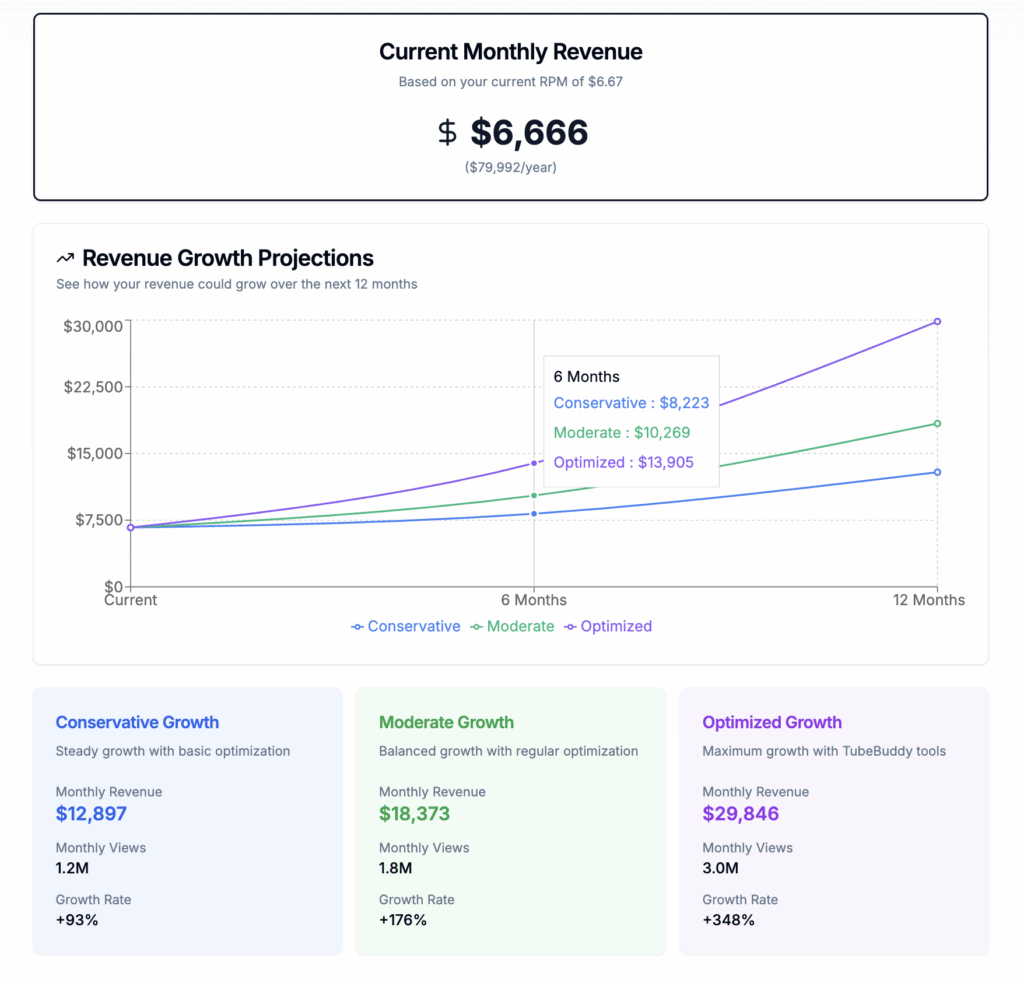
3. Key metrics: CPM, RPM and estimated earnings
CPM (Cost per Mille)
CPM represents what advertisers pay for 1,000 impressions on your videos. Rates vary widely depending on niche, audience demographics, geography and demand.
For example: content in finance, business or tech tends to command higher CPMs due to stronger advertiser demand, while gaming or lifestyle content often sees lower CPMs.
RPM (Revenue per Mille)
RPM is what you — the creator — actually earn per 1,000 views after the platform takes its cut (YouTube keeps 45%, creators receive 55%).
RPM is a better measure of real earnings than CPM, because CPM only reflects what advertisers pay, not what you receive.
For example, a channel with 1,000,000 monthly views and an RPM of $6 can expect around $6,000/month — assuming ads are shown on most views.
Estimated earnings
Estimated earnings are simply RPM × number of views (divided by 1,000). It’s a rough but helpful way to gauge potential monthly or yearly income, provided you understand the variability behind the numbers.
4. Why CPM/RPM vary by niche and audience
Not all content or audiences are valued equally by advertisers — that’s why CPM and RPM fluctuate. Key factors:
- Niche: High-value niches like finance, education, business and tech generally earn more per 1,000 views than gaming or entertainment.
- Audience location: Viewers from countries with high ad spend (like the US, Canada, UK) often bring higher CPMs.
- Engagement and watch time: Videos that hold viewers’ attention longer tend to generate more ad impressions, which boosts revenue.
- Ad demand and seasonality: Advertiser demand fluctuates (e.g., around holidays or big sales seasons), which impacts CPM.
- Ad coverage: Not every view results in an ad — some viewers skip ads, use ad blockers, or come from regions with lower ad rates.
Because of this variability, CPM/RPM numbers should be treated as estimates, not guarantees.
5. How to maximize ad revenue on YouTube
Here are proven strategies to increase what you earn per video:
- Create high-retention content. Videos with strong storytelling, a compelling hook, and steady pacing keep viewers watching — and increase ad impressions.
- Target high-CPM niches and topics. Whenever possible, create content around niches known for better advertiser demand (e.g., finance, tech, education).
- Focus on audiences from lucrative regions. Use analytics to identify where your viewers are based — scheduling uploads and tailoring content to high-value regions can pay off.
- Encourage viewer engagement. Likes, comments, shares and subscriptions improve discoverability — which can lead to more views, more ads played, and higher revenue.
- Diversify revenue streams. Don’t rely solely on ads. Explore memberships, Super Thanks, affiliate links, sponsorships, or selling your own products or courses. This helps stabilize income and reduces reliance on ad fluctuations.
- Stay consistent and quality-driven. Regular uploads, high production standards, and audience trust can contribute to long-term growth — often more valuable than quick spikes.
6. Conclusion: turning views into real earnings
Earning money on YouTube goes beyond chasing views — it’s about understanding how monetization works and using smart strategies to maximize what each view is worth.
With TubeBuddy’s revenue calculator, you gain a clearer, data-driven picture of your potential income. By learning how CPM, RPM and engagement impact revenue — and by aligning your content, audience, and monetization strategies accordingly — you can turn views into a stable, growing income stream.
Get an unfair advantage on YouTube
Give your YouTube channel the upper hand and easily optimize for more views, more subs, and more of every metric that matters.